



One gorgeous spring day in Valle de Guadalupe, as a band played a romantic Mexican folk song, I tasted two Nebbiolos under a 450-year-old oak tree at Casa Magoni winery. Or perhaps I should say I tasted one Nebbiolo and one “Nebbiolo”—in big air quotes.
I was with the 85-year-old winemaker Camillo Magoni, who poured two different bottlings. First, his 2016 Nebbiolo Clone 34, grown from vines native to Valtellina in Italy’s Lombardy region, where Magoni was born. Next came his 2019 Nebbiolo de Baja. The difference was stark: Clone 34 had the light color, finesse, and rose and cherry notes of a young Piemontese Nebbiolo. The Nebbiolo de Baja was darker, more muscular, and more brooding. I enjoyed both, but the question was unavoidable: How were these two wines from the same grape variety?
// Create the element
var script_6a0f7b86a5ee9 = document.createElement(„script“);
script_6a0f7b86a5ee9.innerHTML = `
window.googletag = window.googletag || {cmd: []};
googletag.cmd.push(function() {
var adType = „leaderboard“;
var mapping;
var lbmapping = googletag.sizeMapping()
.addSize([1024, 0], [[970, 250], [970, 90], [1, 1], [728, 90]])
.addSize([728, 0], [[728, 90], [1, 1]])
.addSize([320, 0], [[1, 1], [300, 50], [300, 100], [320, 50], [320, 100]])
.addSize([0, 0], [[1, 1], [320, 50]])
.build();; // Size mapping for leaderboard ads
var medrecmapping = googletag.sizeMapping()
.addSize([1024, 0], [[300, 600],[300, 250]])
.addSize([728, 0], [300, 250])
.addSize([320, 0], [[1, 1],[300, 250]])
.addSize([0, 0], [[1, 1], [300, 250]])
.build(); // Size mapping for med rectengle ads
if(‚/39808611/article_page/article_leaderboard_1‘ == ‚/39808611/article_page/article_leaderboard_1‘
|| ‚/39808611/article_page/article_leaderboard_1‘ == ‚/39808611/article_page/article_leaderboard_2‘
|| ‚/39808611/article_page/article_leaderboard_1‘ == ‚/39808611/article_page/article_leaderboard_3‘) {
mapping = googletag.sizeMapping()
.addSize([1920, 0], [[728, 90]]) // >= 1920px
.addSize([1440, 0], [[728, 90]]) // 1440px-1919px
.addSize([730, 0], [[300, 250]]) // 730px-1439px
.addSize([0, 0], [[320, 100], [320, 50], [300, 100], [300, 50], [300, 250]]) // Up to 729px
.build();
} else {
mapping = adType == ‚leaderboard‘ ? lbmapping : medrecmapping;
}
googletag.defineSlot(‚/39808611/article_page/article_leaderboard_1‘, [[1, 1]],
‚div-gpt-ad-6a0f7b86a5ee9‘).addService(googletag.pubads()).defineSizeMapping(mapping);
googletag.pubads().enableSingleRequest();
googletag.pubads().collapseEmptyDivs();
googletag.display(‚div-gpt-ad-6a0f7b86a5ee9‘);
});
`;
// Append the script to the body
document.body.appendChild(script_6a0f7b86a5ee9);
“Of course they are different,” Magoni said. “But I never have a preference as long as the wine is well made.”
Other Baja winemakers are more blunt about their skepticism toward the so-called Nebbiolo that grows in Baja. “Some people say that it’s Dolcetto or Lambrusco,” said Lulú Martinez Ojeda, winemaker at Bruma, one of Valle de Guadalupe’s most highly regarded producers. “All I can say is it’s not Nebbiolo. I love it, but it’s not Nebbiolo.” Martinez Ojeda says a Mexican-American sommelier in New York once asked about her wine, “So is this Nebbiolo, or is this Nebbio-cholo?”
So, if the Nebbiolo in Valle de Guadalupe is not really Nebbiolo, then what is it?
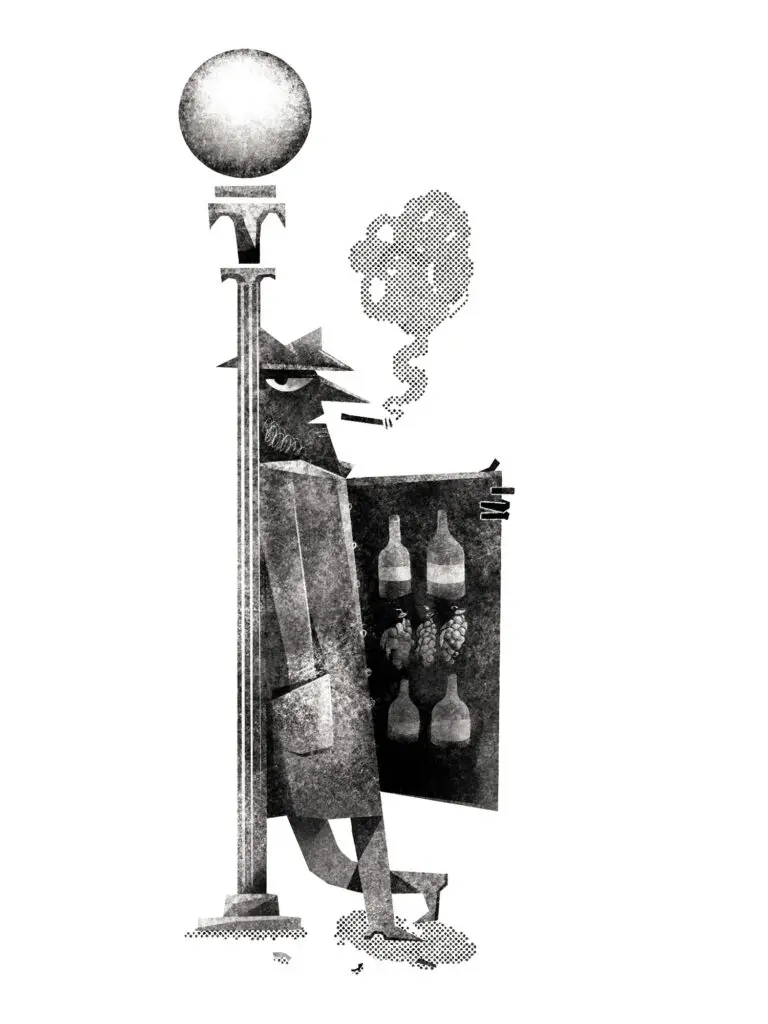 Illustration by Ryan May
Like most up-and-coming wine regions, Valle de Guadalupe has struggled to find a signature grape. The region’s drought conditions and heat lead to a lot of experimentation, and many vineyards grow Chardonnay and Cabernet Sauvignon. Some grow very good Chenin Blanc. Some believe Rhône varieties like Mourvèdre and Grenache do best. Others veer toward Spanish varieties like Tempranillo. Others still insist on Italian grapes like Sangiovese, Montepulciano, and Aglianico.
But for now, the signature grape in Valle de Guadalupe is Nebbiolo. L.A. Cetto, the region’s big legacy producer, has promoted Nebbiolo as the area’s main variety since the 1980s, and it’s been in Baja for at least seven decades. After World War II, many varieties were imported here from Piedmont, including Barbera, Grignolino, Freisa, and “one variety they named Nebbiolo,” Magoni said, with a smirk.
Magoni came to Baja in the 1960s after working in vineyards in Valtellina, a valley in Italy’s Lombardy region, where Nebbiolo is the local grape. “Nebbiolo is probably the variety I know better than any other, so when I arrived in Baja and visited the wineries, I was a little bit shocked,” he said. “Of course, I had my ideas. But I shut my mouth and just observed and didn’t talk.”
 Illustration by Ryan May
The Nebbiolo you taste in Baja is quite different from what you’d recognize in Italian wines made from it, like Barolo or Barbaresco. It’s darker, less tannic, and often has a briny, saline character. Maybe it’s the climate, or the result of growing Nebbiolo in a drought, where the water that remains on the valley’s ocean-bed soil becomes saltier and poorer in quality.
“It’s not Italian. There’s more color, more intensity,” said Paolo Paoloni, an Italian winemaker working for Villa Montefiori in Baja. Paoloni calls his Nebbiolo de Guadalupe. Meanwhile, Magoni has adopted the name Nebbiolo de Baja, presumably in case some DNA testing reveals the grape’s true identity.
Kristin Magnussen at Vinos Lechuza recently released a Nebbiolo aged in stainless steel and sold in a can. She offered a hypothesis: “In Piedmont, it’s a light- skinned grape used to fog. But here, they’re in direct sunlight. Maybe they’ve evolved to have a thicker skin,” she said. “Is it really Nebbiolo? Well, it’s Mexican Nebbiolo.”
“Nobody expects anything mainstream from Mexico, so we can make whatever we want,” said Martinez Ojeda. We were sipping her vibrant Casa Jipi Nebbiolo, which is bursting with fresh red fruit and a touch of minerality. The Nebbiolo for Casa Jipi comes from a vineyard planted in 1978. “Casa Jipi is definitely a Nebbio-cholo. At this point, it’s just a part of us.”
It’s not Italian. There’s more color, more intensity.
Paolo Paoloni, winemaker, Villa Montefiori
There is a long tradition of grapes being called by confusing local names, especially with Italian varieties. Sangiovese is variously called Brunello, Morellino, Prugnolo Gentile, and two dozen other names. Nebbiolo is called Chiavennasca in Valtellina and Spanna in Gattinara.
Cases of grape identity crisis happen more often than you’d think. The most famous was in Chile, where they discovered that the strange Merlot they were growing was actually Carménère. A similar discovery happened in Colli Berici, in Italy’s Veneto. There, red wines once thought to be Cabernet Franc also turned out to be Carménère, based on DNA testing. While some wineries embraced Carménère as a new signature grape, not all local winemakers were happy about this revelation. Many were Carménère deniers who continued to bottle their wines as Cabernet del Veneto.
Something similar may soon happen in Valle de Guadalupe. I spoke with José Vouillamoz, one of the world’s foremost grape geneticists and co-author of the groundbreaking encyclopedia Wine Grapes. He said at least one DNA test on Baja Nebbiolo showed it could be the grape Lambrusco di Alessandria, which has origins in Piedmont’s Alessandria province. However, Vouillamoz made clear that this was only one sample from one vineyard, and that more testing would be needed before anything definitive could be established. “I can’t say anything until I see the results of DNA profiling,” he said. “Maybe let them know I do perform DNA testing on a regular basis.”
“So why hasn’t there been a DNA test?” said Martinez Ojeda. “Well, that’s very expensive. But maybe it’s time.” She added, “If you find out that it’s not Nebbiolo—that it’s Dolcetto or Freisa or whatever—then what? Then what do you do?”
// Create the element
var script_6a0f7b86a828c = document.createElement(„script“);
script_6a0f7b86a828c.innerHTML = `
window.googletag = window.googletag || {cmd: []};
googletag.cmd.push(function() {
var adType = „leaderboard“;
var mapping;
var lbmapping = googletag.sizeMapping()
.addSize([1024, 0], [[970, 250], [970, 90], [1, 1], [728, 90]])
.addSize([728, 0], [[728, 90], [1, 1]])
.addSize([320, 0], [[1, 1], [300, 50], [300, 100], [320, 50], [320, 100]])
.addSize([0, 0], [[1, 1], [320, 50]])
.build();; // Size mapping for leaderboard ads
var medrecmapping = googletag.sizeMapping()
.addSize([1024, 0], [[300, 600],[300, 250]])
.addSize([728, 0], [300, 250])
.addSize([320, 0], [[1, 1],[300, 250]])
.addSize([0, 0], [[1, 1], [300, 250]])
.build(); // Size mapping for med rectengle ads
if(‚/39808611/article_page/article_leaderboard_2‘ == ‚/39808611/article_page/article_leaderboard_1‘
|| ‚/39808611/article_page/article_leaderboard_2‘ == ‚/39808611/article_page/article_leaderboard_2‘
|| ‚/39808611/article_page/article_leaderboard_2‘ == ‚/39808611/article_page/article_leaderboard_3‘) {
mapping = googletag.sizeMapping()
.addSize([1920, 0], [[728, 90]]) // >= 1920px
.addSize([1440, 0], [[728, 90]]) // 1440px-1919px
.addSize([730, 0], [[300, 250]]) // 730px-1439px
.addSize([0, 0], [[320, 100], [320, 50], [300, 100], [300, 50], [300, 250]]) // Up to 729px
.build();
} else {
mapping = adType == ‚leaderboard‘ ? lbmapping : medrecmapping;
}
googletag.defineSlot(‚/39808611/article_page/article_leaderboard_2‘, [[1, 1]],
‚div-gpt-ad-6a0f7b86a828c‘).addService(googletag.pubads()).defineSizeMapping(mapping);
googletag.pubads().enableSingleRequest();
googletag.pubads().collapseEmptyDivs();
googletag.display(‚div-gpt-ad-6a0f7b86a828c‘);
});
`;
// Append the script to the body
document.body.appendChild(script_6a0f7b86a828c);
Back at Casa Magoni, as our tasting under the old oak tree moved into a leisurely afternoon of wine drinking, I proposed a similar question: “So, have you done DNA testing?
Magoni laughed. “Yeah,” he said.
“And?”
“Who cares?” he said with a shrug.
This article originally appeared in the June/July 2026 California Issue of Wine Enthusiast magazine. Click here to subscribe today!
More Wine Coverage
- Learn more about Moscato d’Asti through Jeff Porter’s conversation with Giacomo Pondini, director of Asti DOCG.
- Take a peek into what it’s really like to be a postpartum drink professional.
- Quiet luxury has arrived in Napa Valley’s tasting rooms, and Mondavi’s redesign proves it.
- Here’s why you should take the kids on your next wine trip.
- Check out this guide to the best wine pairings for classic Spanish dishes.
From the Shop
Find Your Wine a Home
Our selection of red wine glasses is the best way to enjoy the wine’s subtle aromas and bright flavors.
Shop Wine Glasses
The post Is Mexican Nebbiolo… Actually Nebbiolo? appeared first on Wine Enthusiast.
Ref: https://www.wineenthusiast.com/culture/wine/mexican-nebbiolo-mystery/