


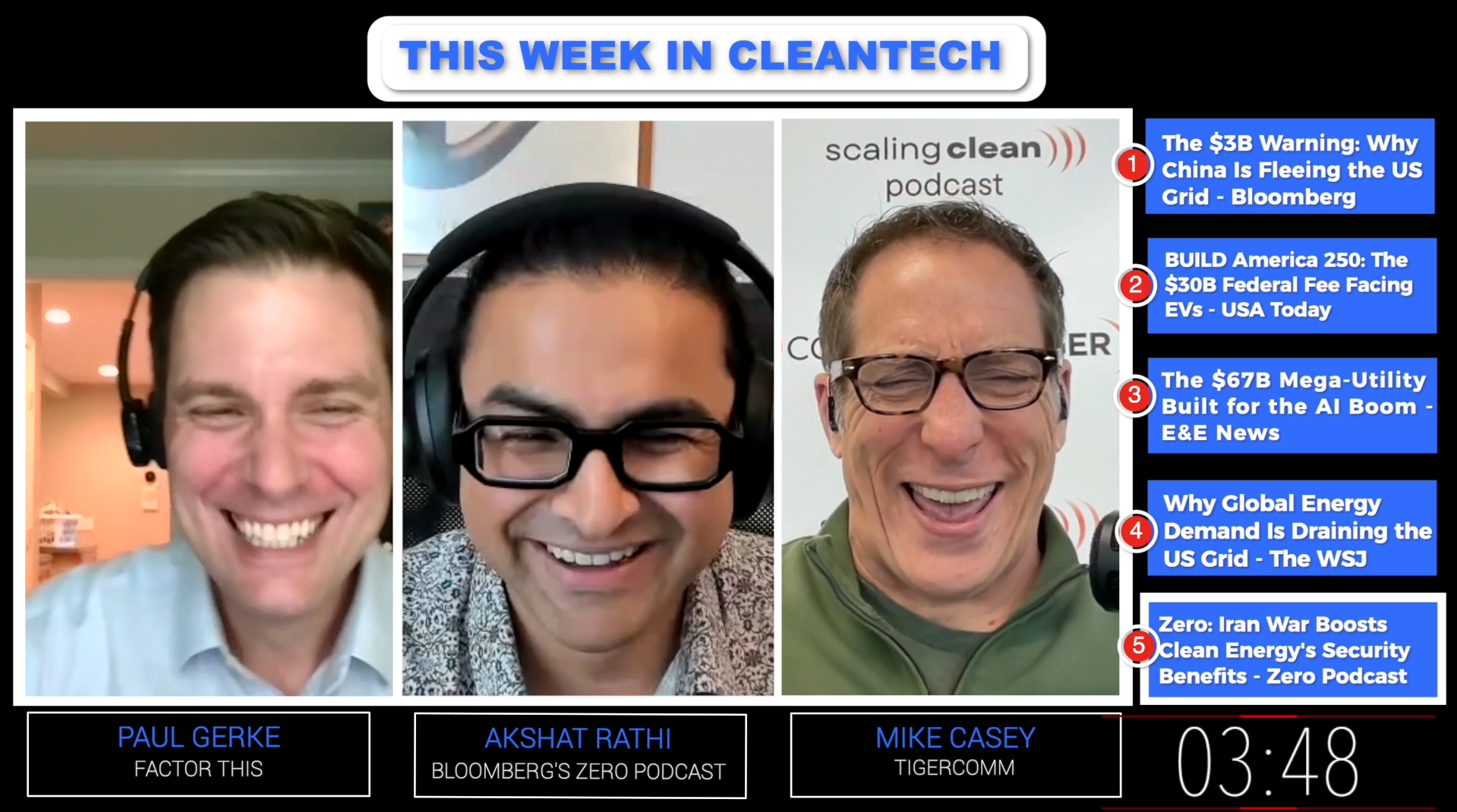

This Week in Cleantech is a weekly podcast covering the most impactful stories in clean energy and climate featuring Paul Gerke of Factor This and Tigercomm’s Mike Casey.
This week’s episode features special guest Akshat Rathi from Bloomberg News, who discussed how the Iran conflict is boosting the security benefits of clean energy.
This week’s “Cleantecher of the Week” is a tribute to a life and career that left an indelible mark on the clean energy community. Jake Clark spent his career at Encore Renewable Energy, most recently pivoting from Vice President of Project Development to stand up the company’s Community Engagement program. Those who knew him describe him as one of those rare people who made the whole field better through both his work and who he was. The clean energy community is smaller without him. We honor his memory and the standard he set for all of us.
Jinko Solar, a major solar manufacturer, recently sold a 75% stake in its Florida facility to a private equity fund, citing the need to comply with US manufacturing regulations and minimize operational risks. The retreat follows a boom period when Biden-era tax credits attracted $5.6 billion in announced Chinese cleantech investments in 2023 alone, incentives that have since been rolled back under the Trump administration.
Chinese cleantech companies scrapped roughly $2.8 billion in planned US manufacturing projects in 2025, with more than half of all proposed Chinese cleantech investments since 2022 canceled, paused, or delayed.
A bipartisan group of leaders on the U.S. House Transportation and Infrastructure Committee is pushing for a new annual fee for EV owners. The proposed fee, included in the bipartisan BUILD America 250 Act, would start at $135 annually in October 2026 and rise by $5 each year up to $150. Plug-in hybrid owners would face a smaller fee starting at $35, maxing out at $50 by 2031.
The White House selected Florida-based energy giant NextEra in March to construct two large natural gas plants in Pennsylvania and Texas as part of a $550 billion trade deal with Japan. Yet even while embracing Trump’s push for expanded gas production, NextEra executives told financial analysts that renewables and batteries remain the fastest path to meeting surging energy demand from data centers.
Now, NextEra’s proposed $67 billion merger with Virginia-based Dominion Energy could put those competing energy strategies to the test. The merger would create a utility giant rivaling some of the nation’s biggest oil companies by market value, while handing NextEra a stake in one of the country’s hottest data center markets. It would also put the company in charge of America’s largest offshore wind project.
Trump’s efforts to contain American energy prices, combined with the country’s huge surplus, have prompted overseas buyers to purchase large volumes of US oil, gasoline, and jet fuel that they aren’t getting from the Middle East. For now, the US has been able to meet domestic needs while filling some of the gap left by missing Gulf barrels, shipping 14.2 million barrels of crude and refined products a day last month, a level no country has ever reached. But producers are barely increasing output, refineries are already operating at capacity, and domestic stocks are depleting fast, meaning American consumers are likely to keep paying more for fuel to stay inside U.S. borders.
The “mid transition” describes the difficult period where fossil fuel and clean energy systems coexist, each large enough to constrain the other, forcing countries to pay for both simultaneously. The fastest path through is to accelerate rather than slow down, since costs drop significantly once the fossil system can finally be retired. Political barriers, not technology or cost, are the primary obstacle, as clean energy is already cheaper in most cases but faces bans, regulatory hurdles, and entrenched institutional structures. Despite the challenges, recognizing these risks early before the hardest operational constraints hit gives the world a genuine opportunity to manage the transition well.
Ref: https://www.renewableenergyworld.com/podcasts/iran-conflict-makes-clean-energy-look-more-secure-this-week-in-cleantech/