

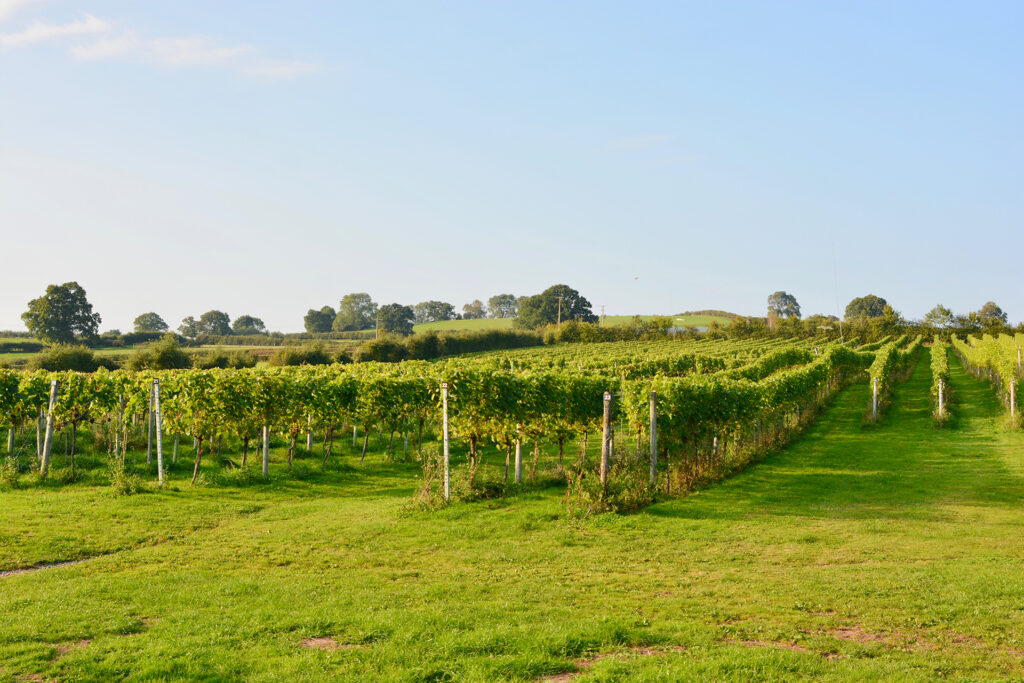

Welsh wine is rapidly emerging as a serious, distinct wine-producing nation, showing substantial growth from 6 to 60 vineyards in 16 years. A promising 2025 vintage, increasing awards, government support, and new facilities highlight a bright future. Despite its small scale and challenging maritime climate, specific microclimates allow varieties like Solaris, Chardonnay, and Pinot Noir to thrive. Wales is particularly known for its thriving natural wine scene, pioneered by biodynamic estates like Ancre Hill. While facing hurdles like extreme weather and often processing wine in England, dedicated small-scale producers are fostering individuality, carving out a unique space for Welsh wine.
English wine has garnered ample attention and grown substantially in recent years. But it’s not the only country in the United Kingdom with a rapidly expanding wine industry. England’s neighbor to the west, Wales, is emerging as a serious wine-producing nation in its own right. A promising 2025 vintage—one many producers claim is the nation’s best yet—along with an increase in creative, natural-leaning producers, an expanding stack of awards, new winery facilities, and freshly awarded government support all point towards a bright future for Welsh wine.
Getty Images
Small yet Mighty
Let’s not get too carried away, though. Compared to England, which has nearly 12,000 acres planted to vines (as of 2025), Wales claims just over 230 acres. Over 1,100 vineyards are registered in England. Wales has just 60.
However, 60 is a whole lot more than six. That was the figure 16 years ago, one of the nation’s long-standing producers, White Castle Vineyard Proprietor Robb Merchant, told me in an email. one of the nation’s “The majority [of Welsh vineyards] are less than two hectares [or five acres],” he says.
These small vineyards are scattered around the edges of a nation that spans just over 8,000 square miles, a little smaller than New Jersey. Roughly 25% of Wales’s terrain is mountainous and therefore un-plantable (heck, unlivable). But these same ranges—namely Snowdonia in the north, the Cambrian Mountains in the middle, and the Brecon Beacons in the south—act as barriers for the wind and rain that thunders in off the Atlantic Ocean. Surrounded by water on three sides, Wales’s climate is indisputably maritime. But warm, dry pockets abound, if you know where to look for them. As wine writer and presenter Oz Clarke, member of Order of the British Empire (OBE), recently said in a presentation for Welsh Wine Week:
“[In Wales,] you can’t just pick a county, as some winemakers in England seem to do, and say, ‘Oh, that’ll be just right for a vineyard.’ You have to be far more specific.”
// Create the element
var script_6a31bdd52b3e5 = document.createElement(„script“);

script_6a31bdd52b3e5.innerHTML = `
window.googletag = window.googletag || {cmd: []};
googletag.cmd.push(function() {
var adType = „leaderboard“;
var mapping;
var lbmapping = googletag.sizeMapping()
.addSize([1024, 0], [[970, 250], [970, 90], [1, 1], [728, 90]])
.addSize([728, 0], [[728, 90], [1, 1]])
.addSize([320, 0], [[1, 1], [300, 50], [300, 100], [320, 50], [320, 100]])
.addSize([0, 0], [[1, 1], [320, 50]])
.build();; // Size mapping for leaderboard ads
var medrecmapping = googletag.sizeMapping()
.addSize([1024, 0], [[300, 600],[300, 250]])
.addSize([728, 0], [300, 250])
.addSize([320, 0], [[1, 1],[300, 250]])
.addSize([0, 0], [[1, 1], [300, 250]])
.build(); // Size mapping for med rectengle ads
if(‚/39808611/article_page/article_leaderboard_1‘ == ‚/39808611/article_page/article_leaderboard_1‘
|| ‚/39808611/article_page/article_leaderboard_1‘ == ‚/39808611/article_page/article_leaderboard_2‘
|| ‚/39808611/article_page/article_leaderboard_1‘ == ‚/39808611/article_page/article_leaderboard_3‘) {
mapping = googletag.sizeMapping()
.addSize([1920, 0], [[728, 90]]) // >= 1920px
.addSize([1440, 0], [[728, 90]]) // 1440px-1919px
.addSize([730, 0], [[300, 250]]) // 730px-1439px
.addSize([0, 0], [[320, 100], [320, 50], [300, 100], [300, 50], [300, 250]]) // Up to 729px
.build();
} else {
mapping = adType == ‚leaderboard‘ ? lbmapping : medrecmapping;
}
googletag.defineSlot(‚/39808611/article_page/article_leaderboard_1‘, [[1, 1]],
‚div-gpt-ad-6a31bdd52b3e5‘).addService(googletag.pubads()).defineSizeMapping(mapping);
googletag.pubads().enableSingleRequest();
googletag.pubads().collapseEmptyDivs();
googletag.display(‚div-gpt-ad-6a31bdd52b3e5‘);
});
`;
// Append the script to the body
document.body.appendChild(script_6a31bdd52b3e5);
Welsh Wine: Then and Now
Vines have grown in fits and starts at some stage in Wales since the Roman Empire began. Throughout most of history their impact has been minimal. The climate never got warm enough for grapes to ripen consistently.
Wales’s modern wine industry technically began in the 1960s. But it took the better part of a half century to move beyond amateur endeavors. Only in the last 25 years has the nation’s wine scene risen to a level of professionalism worthy of global recognition. This, in large part, is due to improved viticultural knowledge—a better understanding of what kind of grapes grow well where.
Today, over two dozen wine grape varieties grow as far north as Anglesey, an island off the northwest coast. But, as in England, wine grapes seem happiest in the Southeast, particularly in Monmouthshire, home to the majority of Welsh vineyards. This part of Wales can get as many sunshine hours as England’s sunniest counties of Essex and Kent, allowing not just the cold-hardy German hybrids created in the mid-20th century such as Rondo, Regent, and Ortega to thrive, but vinifera too. Chardonnay and Pinot Noir lead the pack. Albariño makes an appearance, particularly at biodynamic estate, Ancre Hill; and Wales’s first 1,000 vines of Cabernet Franc were planted by Merchant at White Castle in 2019.
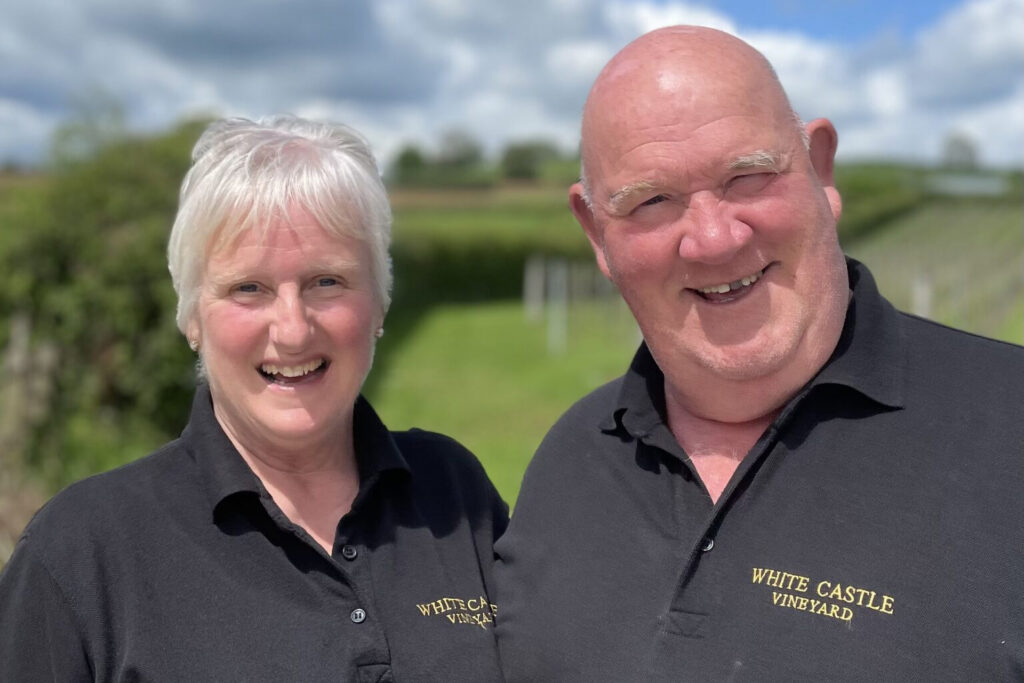 Robb and Nicola from White Castle Vinyard. Courtesy of Robb and Nicola
Stylistically speaking, Welsh wine isn’t drastically different from its English brethren.
“It’s not as marked as you might think,” says British wine writer Susy Atkins. “The climate in south Wales is broadly similar [to England’s]; a bit wetter and windier, though.” Vintages variation is, therefore, more pronounced. “Indeed, it is a real rollercoaster in Wales!”
One grape that does set Wales apart from its eastern neighbor is the white hybrid variety, Solaris. Atkins thinks it stands out as “interesting” due to its bright-fruited, high-acid, easy-drinking nature. At the 2024 Welsh Wine Awards, it was a Solaris from Montgomery Vineyard—described by Atkins as having “plenty of citrus, pineapple and a hint of honeysuckle”—that took home the award for Best Still Wine.
Natty Wines Take Hold
Even more distinguishing than Solaris is Wales’s thriving natural wine scene, one that has gained momentum in recent years thanks in large part to foundations laid by Richard Morris, proprietor of the previously mentioned Ancre Hill.
In 2006, Morris and his wife, Joy, planted 500 Chardonnay and Albariño vines on their property in the Wye Valley in Monmouthshire, on the southeast border with England. Eight years later, they’d expanded to 30,000 vines and added Pinot Noir, Albariño, and other varieties to the mix. They certified the entirety of their vineyards organic and biodynamic, and built a highly sustainable winery made entirely from natural materials like straw bales, lime mortar, and sedum grass.
Today, Ancre Hill leads the charge for biodynamic farming and low-intervention winemaking in Great Britain. The range of wines made by the estate’s longtime winemaker Jean du Plessis includes an electric-hued “Orange Wine” with a distinctive Clockwork Orange label made from a blend of Chardonnay, Albariño, Solaris, and Ortega. It’s gained somewhat of a cult following in Britain. “We were the first U.K. producer of orange wine on a commercial scale,” says Morris. There’re colorful pé-nats and seriously classy traditional method sparklers, too.
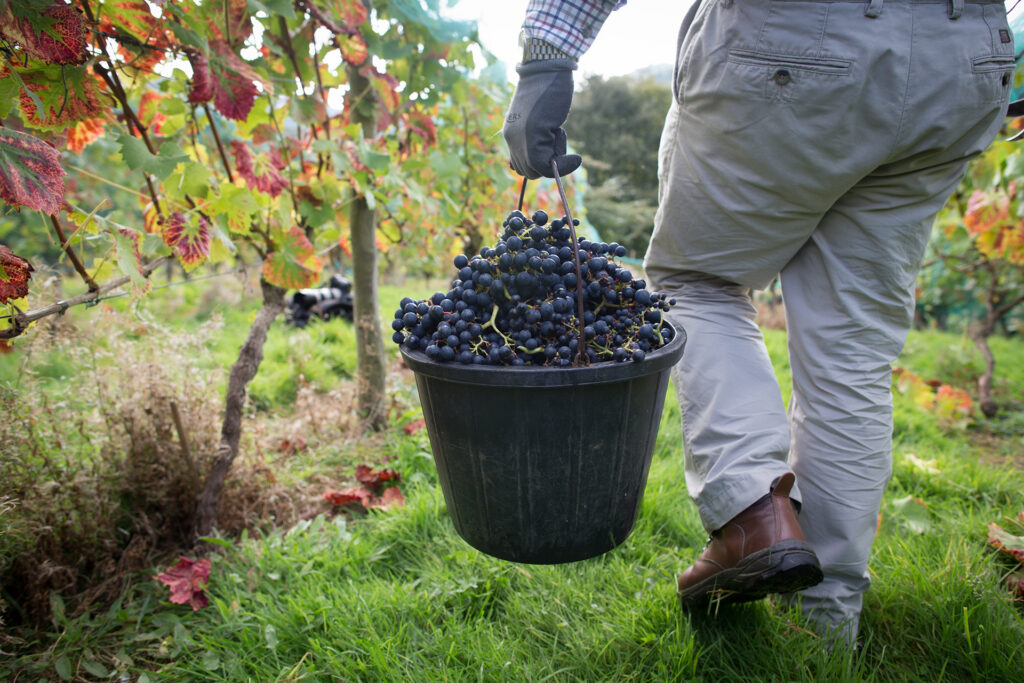 Harvesting grapes in Wales. Photo by Matt Cardy/Getty Images
While Ancre Hill remains Wales’s sole biodynamic certified vineyard, organic and regeneratively farmed vineyards—stewarded by new producers inspired by Morris’s lo-fi approach—are emerging.
One of those producers is Morris’s son David, whom Richard recently sold one of his vineyards to. Along with his own brand, Mountain People, David makes wine for other small brands in the region at his family’s winery, making him Wales’s first contract winemaker.
Paul Rolt and Jemma Vickers of Hebron Vineyard and Winery, located in West Wales in Carmarthenshire county, are two of David’s former clients. The pair moved to Wales in 2010 after nine years establishing an organic vineyard in Andalusia, Spain. David, who shares their “zero zero” approach to winemaking, made wine for Hebron until 2024 when Rolt and Vickers opened their own winery. Today, Hebron’s wines are made from Solaris and Rondo, all fermented in ceramic “tinajas” or amphorae. Rolt is taking the nation’s passion for natural wine to another level.
“I am the lead applicant to protect the name ‘Natural Wine of Wales’ under the Geographical Indications scheme,” he says. Rolt applied in 2021 and says his application is “still progressing with the U.K. government,” but his hope is that by legally defining the term, it will protect natural producers “from brand washing and misinformation”.
Headwinds Abound
Rolt’s concerns with his industry’s future lie not just in misinformation surrounding natural wine marketing, but in the fact that Welsh wines are frequently made outside Wales, and even occasionally blended with non-Welsh fruit.
“Only 10% of vineyards in Wales actually process and vinify in Wales. The vast majority of Welsh wine is made in two wineries across the national border in England,” Rolt says. “If we are to establish Wales as a global wine region, then, of course, we should be working in Welsh wineries with Welsh-grown grapes.”
// Create the element
var script_6a31bdd52bb88 = document.createElement(„script“);
script_6a31bdd52bb88.innerHTML = `
window.googletag = window.googletag || {cmd: []};
googletag.cmd.push(function() {
var adType = „leaderboard“;
var mapping;
var lbmapping = googletag.sizeMapping()
.addSize([1024, 0], [[970, 250], [970, 90], [1, 1], [728, 90]])
.addSize([728, 0], [[728, 90], [1, 1]])
.addSize([320, 0], [[1, 1], [300, 50], [300, 100], [320, 50], [320, 100]])
.addSize([0, 0], [[1, 1], [320, 50]])
.build();; // Size mapping for leaderboard ads
var medrecmapping = googletag.sizeMapping()
.addSize([1024, 0], [[300, 600],[300, 250]])
.addSize([728, 0], [300, 250])
.addSize([320, 0], [[1, 1],[300, 250]])
.addSize([0, 0], [[1, 1], [300, 250]])
.build(); // Size mapping for med rectengle ads
if(‚/39808611/article_page/article_leaderboard_2‘ == ‚/39808611/article_page/article_leaderboard_1‘
|| ‚/39808611/article_page/article_leaderboard_2‘ == ‚/39808611/article_page/article_leaderboard_2‘
|| ‚/39808611/article_page/article_leaderboard_2‘ == ‚/39808611/article_page/article_leaderboard_3‘) {
mapping = googletag.sizeMapping()
.addSize([1920, 0], [[728, 90]]) // >= 1920px
.addSize([1440, 0], [[728, 90]]) // 1440px-1919px
.addSize([730, 0], [[300, 250]]) // 730px-1439px
.addSize([0, 0], [[320, 100], [320, 50], [300, 100], [300, 50], [300, 250]]) // Up to 729px
.build();
} else {
mapping = adType == ‚leaderboard‘ ? lbmapping : medrecmapping;
}
googletag.defineSlot(‚/39808611/article_page/article_leaderboard_2‘, [[1, 1]],
‚div-gpt-ad-6a31bdd52bb88‘).addService(googletag.pubads()).defineSizeMapping(mapping);
googletag.pubads().enableSingleRequest();
googletag.pubads().collapseEmptyDivs();
googletag.display(‚div-gpt-ad-6a31bdd52bb88‘);
});
`;
// Append the script to the body
document.body.appendChild(script_6a31bdd52bb88);
While warming temperatures benefit those grapes, which ripen easier with heat, Wales also has a unique set of climatic hurdles to contend with. Its exposed location at the edge of an island, perched in the North Atlantic means that cold winds—sometimes as low as 14℉—collide with budding vines in early springtime. Winds in late summer can reach as high as 80 miles per hour, battering the vines. There can be two months straight of 100% cloud cover during half of the growing season. And new rainfall records continue to be set, year after year. “Our biggest challenge is climate change,” says Rolt. “I cannot mitigate that.”
Despite the challenges, Welsh wine is well-placed for success thanks to a growing number of producers ensuring its place in the nation’s future.
“Welsh wine is having a moment of good reviews and recognition,” says Merchant. “The growers are small scale and therefore give their vines and grapes more attention. This allows for producers to seek their own individuality.”
This individualism is helping the entire category to carve out its own space in a now-crowded wine world. It’s a space we should all be watching.
More Wine Coverage
- A wellness resort where wine and cocktails are part of the program? Yes, you read that right.
- It’s officially rosé season, and we rounded up our favorites from around the world.
- More of a white wine drinker? From light and fresh to full and complex, Gavi does it all.
- Director of Digital Product Jessyca Frederick visited Wine Enthusiast HQ to learn how to calibrate wine like our writers at large.
- Beyond red drink, wine pros share the wines they’re reaching for to celebrate Juneteenth.

In the Shop
Bar Cabinets: Wine & Spirits Furniture
Display (or hide) your bottles in style with versatile pieces in a variety of shapes and customizable refrigeration options.
Shop Now
The post Welsh Wine Would Like Your Attention, Please appeared first on Wine Enthusiast.
Hinweis: Externer Inhalt von https://www.wineenthusiast.com/basics/region-rundown/welsh-wine/. Rechte bei den jeweiligen Urhebern. » Mehr… » Melden